Snoring has been viewed as a simple inconvenience, but on a medical level, it is a potential first indicator of sleep apnea, which is a severe disease disorder of the sleeping process. Sleep apnea when untreated may cause chronic fatigue, cardiovascular diseases, metabolic malfunctions and decreased quality of life. Now, due to the emergence of artificial intelligence in the medical field, the diagnosis of sleep apnea is not confined to the hospital or sleep laboratory. Early, home-based screening and diagnosis is now possible thanks to AI-driven tools, and it changes the relation of people to sleep health.
AI and Snoring and Sleep Apnea Diagnosis
Conventional diagnoses of sleep apnea had been associated with wasting time and money in hospitals and also lengthy queues. These obstacles made several people postpone or evade tests. This friction has been greatly minimized through AI which has introduced AI face scanner for sleep apnea and home sleep apnea screening AI serving as the initial step to risk identification.
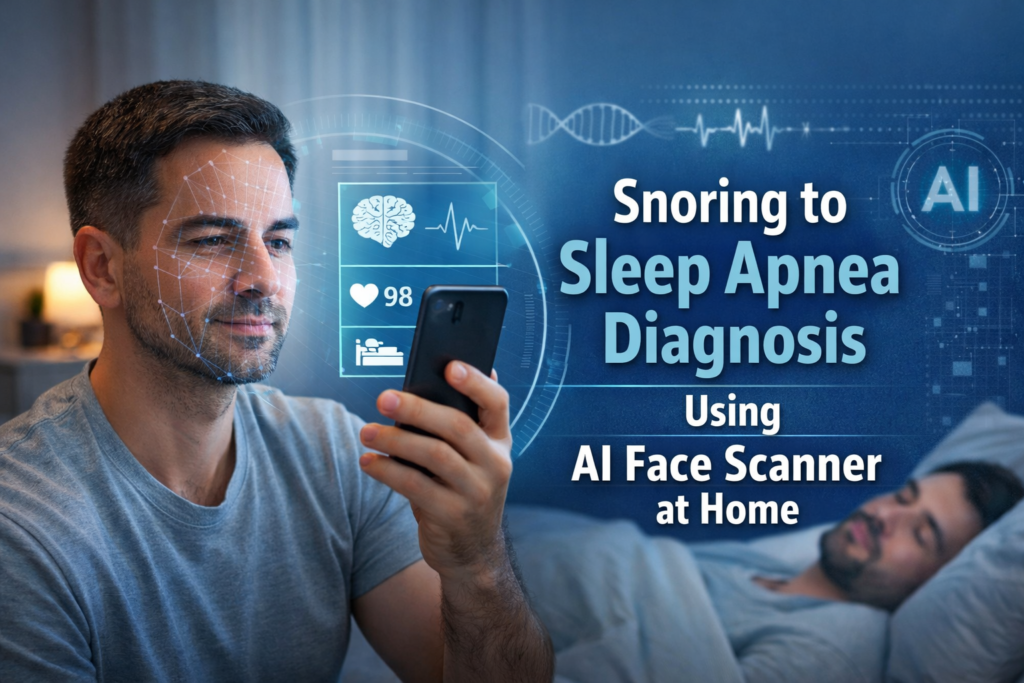
They are AI-based systems that examine the facial features and other risk factors to determine the likelihood of Obstructive Sleep Apnea (OSA) in minutes. This renders them very useful in individuals who require a snoring examination in the comfort of their homes or a preliminary examination without the complexity of visiting a doctor.
Face Scanner AI to Sleep Apnea: A Smarter First Gear.
The technology of AI facial scanning is uninvasive, quick, and non-invasive. It enables the snorers to promptly know whether they have symptoms that can be associated with sleep apnea or not.
Key benefits include:
Fastest response within 2 minutes.
No visits or equipment needed to the hospital.
Clarity on the need to undertake additional testings.
Such a strategy promotes timely intervention and reduces the gap existing between diagnosis and awareness.
Home Sleep Apnea and Sleep studies.
When the AI screening screening shows that there is a possible risk, the following action is to confirm the diagnosis through a sleep study test machine at home. This allows examining sleep apnea without going to the hospital, which is comfortable and clinically reliable.
Level 2 Sleep Study in India
Level 2 sleep study is an in-depth diagnostic test that is done at home with an elaborate sleep study machine at home. It measures various variables including brain activity, airflow, oxygen saturation, heart rate, and breathing effort, and is as accurate as studies in a hospital.
Level 3 Sleep Study in India
A Level 3 sleep test is concerned with respiratory parameters and oxygen levels. It suits middle to high-risk patients and offers a cheaper and simplified-testing method.
The two are extensively applicable and acceptable in the diagnosis of sleep apnea severity.
Patient Compliance, Convenience, and Cost.
In-home testing enhances compliance and comfort, because the patients sleep in their own natural conditions. The price of a sleep study test in India will vary depending on the level of study chosen between Level 2 and Level 3 study, however home studies are usually cheaper and can be done without travelling and the cost of admission.
Most Commonly Asked Questions :
How technology can help for Snoring and Sleep Apnea Diagnosis?
Digital health screening for sleep disorders is a new advancement which can help for snoring and sleep apnea diagnosis. If somebody snores he can screen himself for risk of Sleep Apnea with AI based screening. This can give instant results in 2 minutes for the risk.
Is there any health monitoring AI device for snoring and sleep apnea ?
Yes , Now AI can help for snoring and sleep apnea diagnosis. AI Facial scan for Sleep Apnea risk prediction is a latest technology which can help a person to know about the risk of OSA ( Obstructive Sleep Apnea ) .
How to go ahead to address snoring and sleep apnea diagnosis?
If some snores first he/she should screen himself for the risk and if he/she is identified with a risk then a sleep study can be done to diagnose the severity of Sleep Apnea.
Final Takeaway
Sleep studies and snoring diagnosis are being redefined with the assistance of AI-based screening and home-based sleep studies. Through the integration of home sleep apnea screening AI, AI face scanning, and stable sleep study test machines, people can be able to shift their symptoms to the diagnosis with less inconvenience and hospital dependence, and thus timely treatment and improved long-term health results will be achieved.