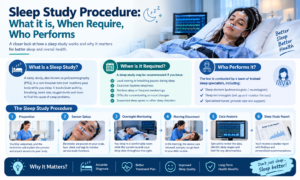
A sleep study is a test conduct on an overnight basis which can record the heart rate, brain waves, breathing, oxygen level, and muscle movements to record any disorders like narcolepsy, apnea, restless legs syndrome.
This Sleep study procedure is also known as Polysomonography and can help you diagnose many sleep related problems. Read this guide for a complete step by step process on how to do it at home.
Sleep Study Procedure: Key Takeaways
- A sleep study test is use by doctors to investigate things such as abnormal movements during sleep, sleep disorders, sleep apnea, and more.
- Overnight sleep study test or in-lab polysomnography test measures eye movements, muscle activities, breathing, heart rate, and oxygen levels in the body during sleep.
- A home sleep apnea test is suitable for patients having suspected obstructive sleep apnea using fewer sensors.
- It is important to ensure that you follow instructions provide by healthcare providers.
- Most of the healthcare experts would advise you not to take caffeine, alcohol or some medication before attempting this test.
- You can take sleep assistance from the healthcare team you are in touch with if you have difficulty sleeping.
What is a Sleep Study?
A Sleep study test can help you diagnose various functions of the body when you are asleep. The full name of the Overnight Sleep Study Test is known as Polysomnography (PSG).
Symptoms such as loud snoring, breathing pauses during sleep, gasping for air while sleeping, persistent daytime sleepiness, and difficulties in maintaining natural sleep patterns.
There are different sleep activities which should be perform. An in-lab polysomnography can assess many parameters of sleep which involves assessing the symptoms of obstructive sleep apnea.
A sleep study may help doctors investigate:
- Obstructive sleep apnea and other sleep-related breathing problems
- Unusual movements during sleep, such as periodic limb movements.
- Unusual behaviors during sleep
- Issues with sleep stages and sleep architecture.
- Persistent sleepiness during the day when additional sleep testing may be appropriate.
- A sleep study does not automatically diagnose any sleep disorder.
Rather, the results of the sleep study are consider in conjunction with the patient’s symptoms, medical history and other tests.
When You Require Sleep Study?
A Sleep Study is a diagnostic test that can be use to rule out health issues. This test is generally recommend when healthcare experts diagnose any kind of symptoms that affect sleep to determine how to treat those conditions or to see if complete treatments works.
You might get recommend for a sleep study test when you include the following.
- Narcolepsy
- Sleep Apnea
- Insomnia
- Night Terrors
- Limb movement disorder
- Night Terrors
- Sleep Walking
- Sleep Paralysis
- Disruptive Sleep Disorders
You will have to perform your sleep study test when you go to sleep. There are people who often have overnight hours and night shifts. If you have night shifts then you can schedule a sleep test during morning hours.
If you want to check and compare the pricing of sleep study please check out our sleep study cost guide
Who Performs Sleep Study?
The sleep study is perform by medical technicians, technologists, assistants and nurses (including registered nurses and licensed practice nurses) who are under the direction of the sleep physician.
A physician, such as a pulmonologist or sleep medicine specialist, will review the data collected during your sleep study. He or she may work with other providers, such as a neurologist, primary care provider, and more to obtain more information about your health history and/or current health status.
They may also contact your other health care provider(s) to share the results of your sleep study so that both of you can continue to provide you with the best possible care.
What Sensors Are Used In Sleep Study?
Sleep study equipment tracks various physiological aspects of your body while you sleep in order to determine your sleep quality and look for possible sleep disorders.
Each sensor is used to measure a certain type of activity such as brain waves, heart rate, muscle activity, eye movements, airflow through the nose and mouth, chest and abdominal movement during breathing, and blood oxygen levels.
A sleep study can use several different sensors and monitoring methods, including:
- EEG (Electroencephalography): This sensor is use to record the brain electrical activity which is known as brain waves. There are several small electrodes attached with the help of conducting gel. Experts can collect information on different stages of sleep on possible sleep disorders.
- Electrocardiography (ECG or EKG): This sensor is use to measure the activity of the muscles related to face, legs, or chin. This can help to determine the degree of muscle relaxation during the different sleep stages and also to detect unusual movements and muscle activity during sleep.
- Electro-oculography (EOG): Sensors around the eyes measure the activity of the muscles around the eyes in order to recognize REM sleep and to distinguish REM sleep from other sleep stages.
- Respiratory inductance plethysmography (RIP) belt: This belt is tie around the chest to measure the movement to measure breathing effort and detect any possible changes in breathing during the night.
- Pulse oximeter: A pulse oximeter is placed on the finger using a small sensor and measures oxygen saturation (SpO2) and pulse rate. Sleep specialists can use this information to determine if there were any significant oxygen drops during the night.
- Video and audio monitoring: Video and audio recordings of your movements, sounds, snoring, etc. can be use by the sleep technician and by the healthcare professional to observe and to better understand any unusual events that may occur during the sleep study. These recordings can be synchronize with the data from the other sensors to help understand the results of the sleep study.
The equipment used in a sleep study is dependent on the type of study that is being performed as well as the symptoms that the patient is experiencing.
What Should I Expect During a Sleep Study?
You will have to reach the healthcare center or you can request a service at home. Healthcare will assist you by attaching the sensors at various places on your body. Sensors generally come with adhesive ground make sure you start with the sensors.
Make sure the sensors are calibrated before starting the process. You can confirm this by moving your eyes, closing your mouths, and moving your legs.
Try to calm yourself and sleep. Usually people get comfortable and are not able to sleep due to a lot of sensors around them. However, not sleeping won’t be impacting your study results.
- If a sensor gets disconnected a staff will help you reattach them, you will be all covered.
- If you have a health condition like seizure or other potential medical emergency you might reconsider or leave the process in between.
How Does a Home Sleep Study Test Work?
A home sleep study is a test of your sleep that you can do in your own home. Most home sleep studies are home sleep apnea tests (HSATs) and can help determine whether you have obstructive sleep apnea.
This home sleep study is different from the in-lab sleep study (polysomnogram) as it utilizes less monitoring than the in-lab sleep study and only measures certain aspects of sleep. The healthcare provider will determine if a home sleep study is appropriate for a patient based on the symptoms being experience and the patient’s medical history.
Step 1: Receive the Home Sleep Testing Equipment
The equipment for home sleep testing may be given to you at the clinic where you were assessed, or it can be delivered to your home. The kit might consist of airflow sensors, finger sensors, monitoring device and straps, user manual with instructions.
Step 2: Go through the instruction first
The healthcare professional will teach you how to set up the sensors, how to start and stop the test and how to check that the test is recording.
You can connect with our experts while going through the instructions for any kind of guidance you might need.
Step 3: Set Up the Equipment Before Bedtime
At your normal bedtime, attach the sensors as instructed by your provider and turn on the device as instructed by your provider.
While you sleep, the equipment will record data on your breathing, pulse and oxygen levels. Continue with your normal routine for sleep.
Step 4: Unwire and Repack
After the overnight reading you have to return the equipment to the clinic as soon as possible while following the arrangement procedure.
The provider will check the recording and arrange for the results to be review. Sometimes the results of a home sleep study are not complete, are not of good quality, or do not explain a patient’s symptoms. In these situations you might get recommend for another test.
Is A Home Sleep Test Better Than In-Lab Test?
No, a home sleep test is not something you would get recommend by the health experts. However, in special conditions it can be allow.
For most adults with possible obstructive sleep apnea, home testing is use. When a doctor wants to look for other sleep disorders, or when a patient’s health situation makes home testing difficult, an in-lab sleep study may be need.
A negative or inconclusive home test does not necessarily rule out sleep apnea and further evaluation, including an in-lab sleep study, may be necessary if your symptoms persist.
Are there any Side Effects of Sleep Study Test?
There are nil to very few complications of Sleep Study Test. These are most likely to be irritations that might become prevalent due to the attached sensors.
Complications are not as such but people often complain about not getting sleep with all the sensors on their body. If carried under expert assistance you would see very minimal to no health complications.
How Would I be Getting the Result of the Sleep Study Test?
Breathnest will take the responsibility of getting you your test result. However, you might have to wait for a few days.
You can keep getting the latest updates on your report from our communication platforms. You might get suggestions for getting the test more than one night if the reading from the earlier test was not proper or sufficient.
Connect With us & Get A Free Quote!
At Breathnest you would be getting the complete guidance and supervision you require for the Sleep Study test. There are always hundreds of thousands of tests that take place and can help you diagnose sleep conditions.
Healthcare experts can help you get this test easily. Do not panic and connect with us today.
Frequently Asked Questions
Q1. How long do you have to stay for sleep study?
Ans: Most of the time one time reading or test results are sufficient but you might get recommendation for more tests if the data or testing remains insufficient.
Q2. Can I go to the bathroom during a sleep study?
Ans: Yes, you can use the bathroom during sleep study. However, ensure you communicate properly with your staff member and tell them your request. However, it is advise you to use the restroom before the test begins as sensors might get disturb if went during the test.
Q3. Does a Sleep Study hurt?
Ans: Sleep study is very much painless and you won’t feel anything. You will only have sensors around you covered with adhesive or tapes. You will be under supervision of experts during the test.
Q4. Can I sleep on my side during a sleep study?
Ans: Yes, after all the attachments are done properly you can sleep in your natural position.